Reversi strategy guide
Reversi rewards patience more than greed. Having the most discs in the middle of the game means little – what counts is who controls the corners, who has more moves and who plays last. This guide explains the key ideas, and the four articles below go deeper with board diagrams.
How to win at Reversi: 6 tips
- Take corners. A disc in a corner can never be flipped. More about corners
- Avoid the squares next to an empty corner. A disc on an X-square or C-square often hands your opponent the corner.
- Limit your opponent's moves. Aim for positions where you have many choices and your opponent has few. More about mobility
- Don't grab too many discs early. Fewer discs in the opening usually means more options later.
- Plan for the last move. Near the end, try to play last in each region of empty squares. More about parity
- Look one move ahead. Before you play, check which squares your move opens up for your opponent.
The squares that decide the game
Not every square is worth the same. The four corners are the most valuable: a disc in a corner can never be flipped, and it can anchor whole rows of discs along the edges that stay yours until the end.
The squares next to the corners are the most dangerous. X-squares are diagonally next to a corner: b2, g2, b7 and g7. C-squares are the edge squares right next to a corner: b1, a2, g1, h2, a7, b8, g8 and h7. While the corner is empty, a disc on one of these squares often lets your opponent take the corner. Play there only when the corner is already taken or when every other move is worse.
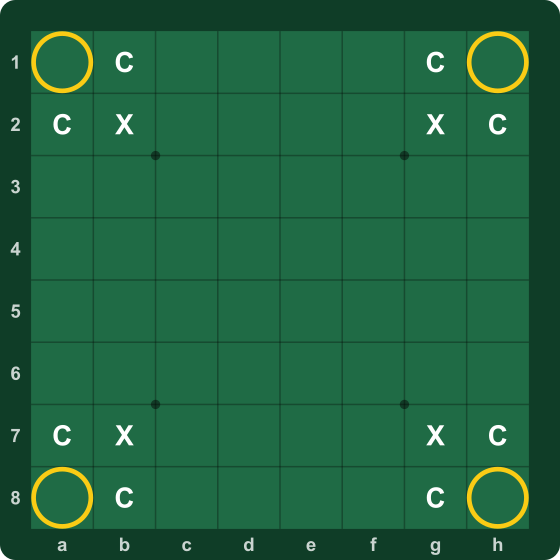
The edges come next. An edge disc can only be flipped along the edge, so it is safer than a disc in the middle. But an edge move can also open the way to a corner, so check what your opponent could play next before you take one. Read more in Corners, X-squares and C-squares.
Count your moves, not your discs
Mobility is the number of legal moves you have. A player with many moves can wait for a good one. A player with few moves is soon forced to play somewhere bad, like next to an empty corner. That is why strong players try to limit their opponent's moves instead of collecting discs.
Two habits help. Prefer quiet moves that flip few discs, ideally discs inside your own position, so that you open no new squares for your opponent. And watch your frontier: discs next to empty squares give your opponent something to flip, while discs in the middle, surrounded by other discs, don't. Read more in Mobility.
The opening: few discs, close to the center
Black's four possible first moves are mirror images of each other, so the first move doesn't matter. What matters is the next dozen moves. Keep your discs close to the center, flip as few as you can, and stay away from the edges early on. A player who grabs many discs in the opening usually runs out of good moves in the middle of the game.
You don't need to memorize long lines. A few named openings, such as the Tiger and the Rose, are enough to start with. Read more in Openings.
The endgame: stable discs and the last move
As the board fills up, count your stable discs: the discs that can no longer be flipped, such as a corner and the unbroken rows of discs that run from it along the edges. They count for you at the end, whatever happens.
Then think about parity. Nobody can answer the last move in a region of empty squares, so it often wins several discs. In a region with an odd number of empty squares, the player who moves there first can usually also move last there, so play in the odd regions first. Read more in Parity, and practice endgames with the Daily challenge.
Common mistakes
- Flipping as many discs as you can. It feels good, but it gives your opponent more moves.
- Playing an X-square next to an empty corner. Your opponent can often take the corner on the next move.
- Filling an edge without checking the corner. Before you play on an edge, look at what it opens up.
- Building walls. A long line of your discs next to empty squares gives your opponent many moves.
- Forgetting about passes. A player with no legal move must pass, so sometimes you can leave your opponent stuck and move twice in a row.
A practice plan for beginners
- Learn the rules. The interactive tutorial teaches them in about 2 minutes.
- Beat Easy. Focus on one thing: never play an X-square while the corner next to it is empty.
- Beat Medium. Before each move, count how many moves your opponent will have afterwards, and prefer the move that leaves the fewest.
- Beat Hard. Plan the endgame: count the empty regions and try to get the last move in each one.
- Learn from every game. Open Key moments after the game and look at the move where you lost the most discs.
Expert is our strongest computer. Beating it takes all of the ideas above, played game after game.
Guides
- Corners, X-squares and C-squaresWhy corners matter, which squares give them away and how stable discs are built
- MobilityWhy fewer discs can mean more moves, and how quiet moves limit your opponent
- ParityHow to get the last move in the endgame, and why it is worth so many discs
- OpeningsYour first moves, White's 3 replies and named lines such as the Tiger and the Rose
For endgame practice, try the Daily challenge: every day there is a position that looks lost but can still be won.
Practice
Reading helps, but playing teaches. Start against the computer on Medium, and move up a level once you win most of your games. After each game, Key moments shows the moves where you lost the most discs. New to the game? Start with the rules or the step-by-step guide.
Play the computer